
Managerial Economics and Business Analysis
Use economic logic and statistics to make complex business decisions, from microeconomic factors to macroeconomic indicators and central bank policy.

What you'll learn
- Use supply, demand and elasticity to explain how markets set prices and how taxes and price controls affect them.
- Explain how market structures, outside shocks and government action shape the way resources are allocated.
- Use Excel to summarize data, test beliefs about populations and make predictions with linear regression.
- Explain how money, banks and central bank policy affect financial markets and the economy.
Skills you'll practice
- Statistical Analysis
- Probability Distribution
- Sampling (Statistics)
- Statistical Hypothesis Testing
- Statistics
- Microsoft Excel
- Financial Market
- Banking
- Economics
- Business Analytics
- Financial Systems
- Supply And Demand
Course by course.
Finish all 6 courses to earn your certificate, in order and at your own pace. At 10 hours a week, they take about 3 months. Open a course to see what it covers.
- 1
Firm Level Economics: Consumer and Producer Behavior 20 hours
Explore elasticity of demand and how taxes and price controls affect market equilibrium. Learn cost theory and how firms make choices based on their costs and market prices. - 2
Firm Level Economics: Markets and Allocations 20 hours
In this course, you will learn to construct demand curves to capture consumer behavior and supply curves to capture producer behavior. The resulting equilibrium price “rations” the scarce commodity. - 3
Exploring and Producing Data for Business Decision Making 20 hours
Use Excel to summarize large data sets with charts, tables and numbers. Learn why proper sampling matters and how samples let you estimate population values. - 4
Inferential and Predictive Statistics for Business 20 hours
Learn to test beliefs about a population, compare populations, and use linear regression to make predictions, using Excel and with a focus on business decisions. - 5
Banking and Financial Institutions 20 hours
Study how money, the financial system and the wider economy connect. See how banks make a profit, how they differ from other lenders and payment providers, and why regulation matters. - 6
Central Banks and Monetary Policy 20 hours
Examine the main goals of central banks and how key money markets work. See how interest rate policy affects inflation and unemployment, and how authorities respond to financial stress.
Your certificates
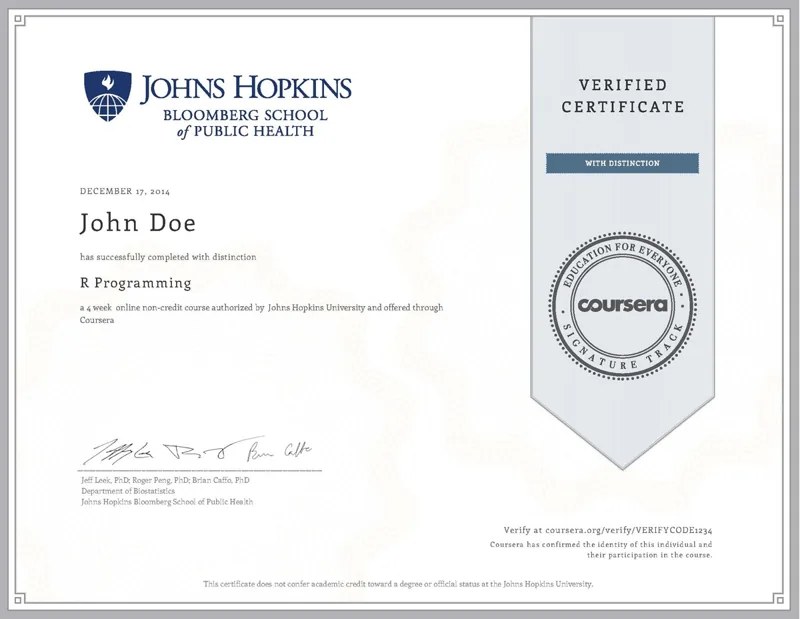

Sample certificates from our top providers. Yours shows your name, your course or program, and the partner that created it.
How it works
- Enroll and payPay once on the secure payment page, by debit or credit card (Visa or Mastercard).
- Activate your accessAccept the email invitation and start learning on Coursera. Your 6 months start then.
- Learn at your own paceVideos, readings and quizzes, on your phone or computer.
- Earn your certificatesOne for each course you finish, then the program certificate at the end. They are yours to keep.
Questions before you enroll
What happens when my 6 months end?
You keep your dashboard, your progress and every certificate you earned. Only your access to that program ends. To continue, renew access for another 6 months for $250.
Do I need experience to start?
No. This program starts from the basics, so no experience in the field is needed.
What language is it taught in?
English. Some programs also offer other languages you can choose from. Talk to our team to check the languages for this program.
Can I add the certificate to my CV?
Yes. Add it to your CV and share it on your LinkedIn profile.
Can I get a refund?
Yes, within 14 days of paying, if you have not activated your access yet. Read the refund policy.
More from the Business Management Academy
See the academy


Ready to start?
Enroll today, then begin whenever it suits you.