Digital Healthcare Informatics and AI
Health Informatics and AI in Healthcare. Master data, AI, and ethics to drive innovation and improve patient outcomes in healthcare.
Frank Naeymi-Rad
Skills You’ll Gain

Shareable Certificate
Earn a shareable certificate to add to your LinkedIn profile..
Develop Your Specialized Knowledge
Learn in-demand skills from university and industry experts
Master a subject or tool with hands-on projects
Develop a deep understanding of key concepts
Earn a career certificate from Illinois Tech
4 courses series
This course provides an in-depth exploration of foundational health informatics and its critical role in modern healthcare. Participants will analyze the historical development and scope of health informatics, emphasizing the importance of data-driven decision-making in enhancing patient care and safety. The course will cover the significance of interoperability in electronic health records (EHRs) and clinical systems, as well as the evolution of major EHR vendors and platforms. Learners will evaluate the challenges of adopting standardized systems and the impact of EHR evolution on clinical workflows and outcomes. Additionally, the course will identify key stakeholders in the healthcare marketplace and explain how market and regulatory dynamics influence informatics adoption. Finally, participants will define and differentiate major terminologies and ontologies, and analyze the role of standardized vocabularies in supporting interoperability.
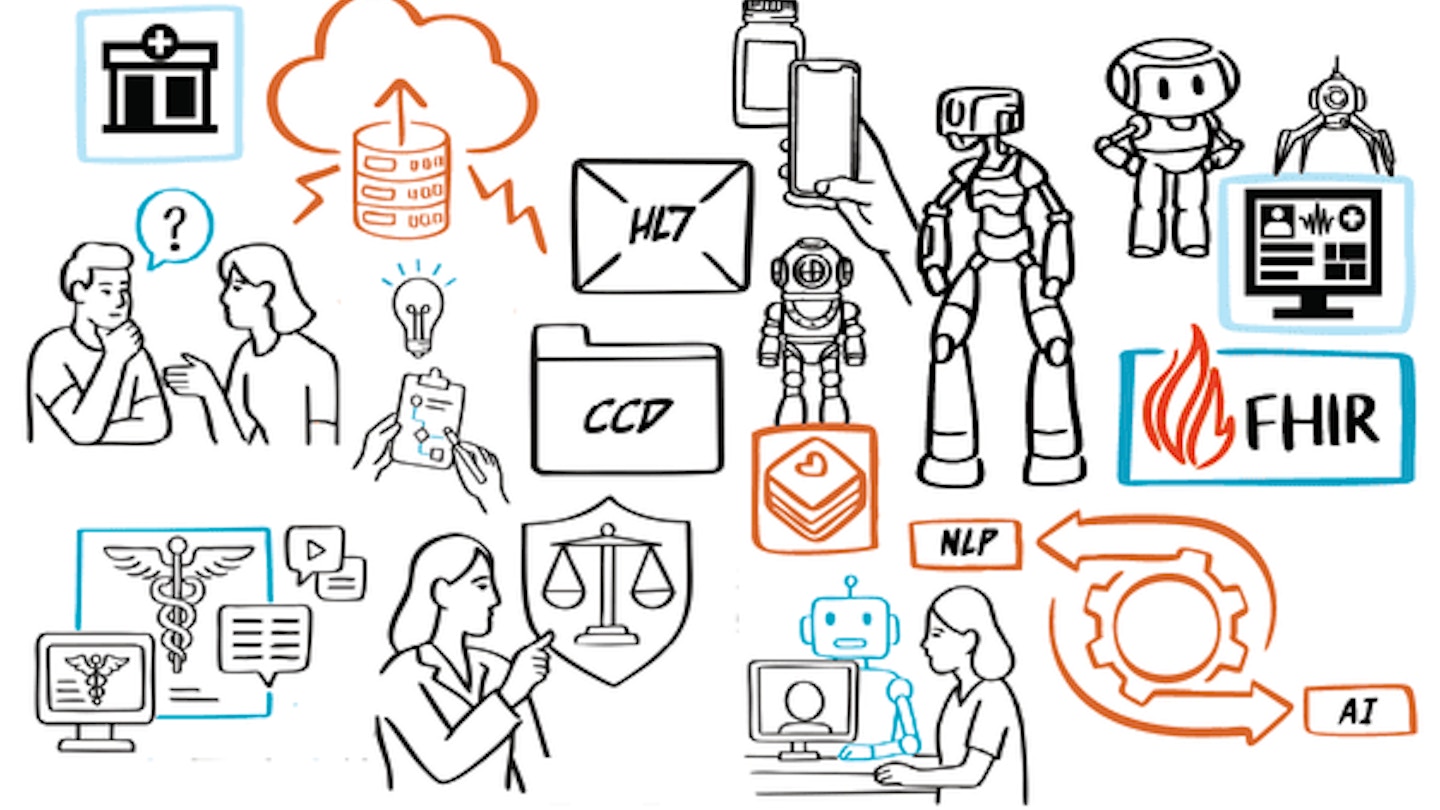
This course provides healthcare professionals and students in health informatics with a comprehensive understanding of healthcare data management and interfaces. Participants will learn about key standards such as CDA, CCD, and USCDI, and how to apply these standards to ensure accurate and interoperable health records. The course will also cover the differences between structured and unstructured data and their implications for patient care.In addition, learners will explore HL7 v2, HL7 FHIR, and SMART on FHIR, and gain hands-on experience using SNOMED CT, LOINC, and RxNorm for structuring health data. The course will evaluate the role of ontologies in semantic interoperability, identify challenges in interoperability, and propose solutions. Finally, participants will assess the potential of blockchain and IoT applications for secure health data exchange.
This course delves into the integration of artificial intelligence (AI) within healthcare, focusing on patient data management. Learners will explore the ethical and policy considerations surrounding AI applications in clinical and public health settings. The course emphasizes the significance of data quality and the potential impact of bias on clinical decision support systems. Participants will gain hands-on experience with AI and machine learning tools, including natural language processing (NLP) applications for clinical note summarization. Additionally, the course covers the integration of AI with electronic health records (EHRs) and clinical decision support systems, equipping learners with the knowledge to leverage AI for improved patient outcomes.
This course is designed for intermediate to advanced students in health informatics who are eager to apply their theoretical knowledge in practical settings. Participants will learn to design and implement real-world projects in both Clinical Health and Public Health environments. The course covers the selection and execution of projects, focusing on innovations that enhance patient and provider experiences through Electronic Health Record (EHR) systems and FHIR servers.Students will gain hands-on experience in integrating with EHR systems, simulating patient journeys, and analyzing population-level trends using large-scale data frameworks. By the end of the course, participants will be equipped with the skills necessary to tackle complex health informatics challenges and contribute to meaningful improvements in healthcare delivery.